Smuggler’s Beat's no-repeat performance practice
The Edge of the WorldSmuggler’s Beat’s no-repeat performance practice is the band’s stated habit of never playing the same show twice. It turns each concert into a distinct event: songs can take unexpected shape in response to the musicians’ instincts and the moment, rather than simply repeating a settled arrangement. The practice is especially clear in Belfast, where an encore becomes an improvised performance that none of the band can fully predict in advance.
A touring habit, not a fixed script
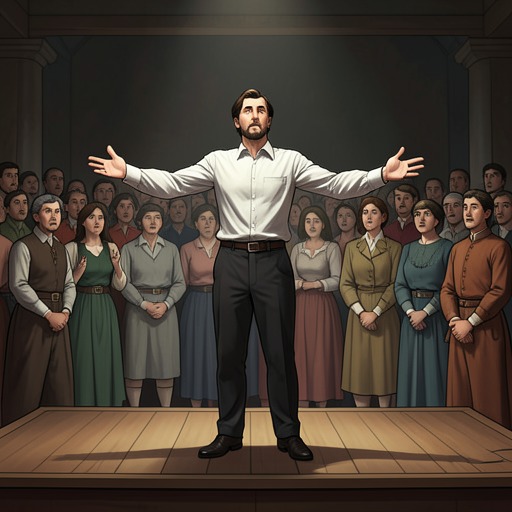
The practice operates within the varied circumstances of touring. At the first stop, Dublin, the band arrives after seven hours on the road, and Shay Maloney slips away from a cramped dressing room to make his solitary circuit of the unfamiliar stage. He lies down on its weathered boards and imagines the sold-out crowd’s response, worrying that the band might fail. The routine gives him a familiar way into a performance, but it does not make the performance itself predictable: each new venue brings a different stage, audience, and possibility of failure.
That tension between preparation and uncertainty also appears in Shay’s exchange with Larry. Larry jokes that a bad show could send Shay back to being an accountant; Shay counters that he barely got GCSEs, comes from Derby, and has never been straight. The banter punctures the pressure without removing it. The band’s refusal to repeat a show is not presented as a guarantee of success, but as a commitment to play in the uncertain conditions that make each night its own.
The Belfast encore
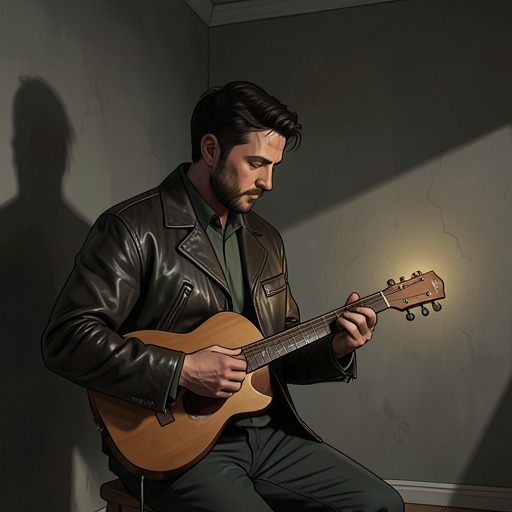
The clearest test comes at the second Belfast show. As Shay closes the sold-out concert on penny whistle, a flatness settles over him, and a mournful melody occupies his thoughts. When the audience calls for an encore, Larry offers him a cajon drum. Shay declines: he feels he must play something entirely new. He lifts a harmonica without knowing what will emerge, and the melody returns, now carrying a grief and sense of inner emptiness he had not recognized as his own.
The performance is improvised, but it is not solitary. Shay falters, and Ben steps forward with a violin, taking up the tune and giving it an Irish lilt that brings the crowd back into the performance. Larry finds a beat; Jumbo adds a forceful bass line; Mara joins on melodeon. Each musician contributes in turn until the arrangement has grown from Shay’s first, uncertain notes into a full-band piece. The scene makes the practice audible as a process: an individual feeling begins the music, while attentive responses from the others shape its course.
Improvisation and the band’s live identity
The Belfast performance shows why the practice matters beyond variation in a set. Shay often turns to harmonica when he has a feeling but no words; here the melody gives form to grief and to missing parts of himself he had not understood. Ben’s ability to read Shay and the audience helps the song move from private anguish toward shared celebration. The band’s responsiveness does not erase the song’s melancholy; it carries that feeling into a collective performance the crowd can receive.
The band’s conduct elsewhere on tour also fits a live identity built around unpredictability. At a Southampton venue, Ollie Pietruska observes Ben on his phone, Jumbo apparently asleep, and Mara at the piano while Larry taps a beat unrelated to the Rachmaninov she is playing. The scene is not itself a performance, but it presents the musicians as working amid disparate impulses rather than a visible, orderly routine. In Belfast, those impulses cohere onstage without becoming a repeated formula. The evidence establishes the no-repeat principle and shows improvisation at its heart; it does not set out a formal rulebook or specify how every concert’s repertoire is arranged.